
The Art of Noticing
September 28, 2026
The Quiet Joy of Noticing: Learning to Pay Attention to Your Own Life
There is a kind of joy that comes from noticing the ordinary things that would otherwise pass us by, those tiny details and fleeting moments that might not seem significant enough to record or remember at the time, but which somehow become meaningful simply because we stopped long enough to pay attention to them.
At this time of year, there is so much to notice. The first leaves beginning to turn gold and copper, the conkers appearing beneath the horse chestnut trees, the berries brightening the hedgerows, the changing quality of the light in the late afternoon and the unmistakable feeling that the landscape around us is beginning to settle into a different rhythm. The birds are changing too, with some of our summer visitors preparing to leave while other species begin arriving here for the winter, and the hedgerows are filling with seeds and berries that will provide food for the birds that remain throughout the colder months.
There are small signs of change everywhere if we slow down enough to see them, and I think there’s something about this particular point in the year that reminds us how much we miss when we are constantly rushing towards the next thing.
Nature doesn’t make a great announcement every time something changes. The seasons move gradually, the trees don’t suddenly decide that autumn has arrived on a particular morning; instead, there is a slow accumulation of tiny changes that we might notice if we are paying attention, and eventually we look around and realise that the world has become something slightly different from what it was a few weeks ago.
I think our own lives are often much the same.
The quiet joy of noticing
We tend to pay attention to the things that feel important, measurable or productive, while everything else becomes background noise, and yet so much of the richness of our lives is actually contained within those ordinary moments that we rarely think to record.
A particular bird appearing in the garden that you haven’t seen for months.
The way the light falls through the window at a certain time of day, creating a patch of warmth across the floor that wasn’t there a few weeks ago.
A sudden shift in your energy that you can’t quite explain, where you realise that something feels different within you even though nothing obvious has changed.
A food you find yourself craving because your body seems to be asking for something slightly different from what it wanted during the summer.
A week when you feel unusually creative and ideas seem to arrive without you having to force them, followed by another when you find yourself wanting more quiet, more space and less stimulation.
The way your mood changes when the evenings become darker, or the way you suddenly find yourself wanting to spend more time at home, cooking, reading, making things, walking or simply being somewhere quiet.
None of these things might seem particularly significant when they happen, and yet they can become incredibly meaningful when we begin to notice them as part of a bigger picture.
There is something wonderfully simple about noticing because it doesn’t require you to change anything immediately. You don’t have to solve the problem, improve yourself, create a new routine or decide what you are going to do differently next month. You can simply observe what is already happening, and there is a lot of freedom and relief in that.
We are often too busy to notice our own lives
So much of modern life encourages us to look ahead: what you’re working towards, what needs organising, what you’re achieving, or need to buy; it’s always what comes next. Another thing to think about, another task to complete, another goal to work towards, another piece of information asking for our attention, and when we spend enough time living this way, it becomes surprisingly easy to move through an entire week without really noticing the experience of actually living it.
We remember what we did, but not necessarily how we felt while we were doing it.
We remember the appointments and deadlines, but not the quality of the light that morning or the bird we heard while making our first cup of tea. We remember that we were busy, but not what our body was trying to tell us while we were busy, and sometimes it is only when we finally stop that we realise just how much information we have been missing.
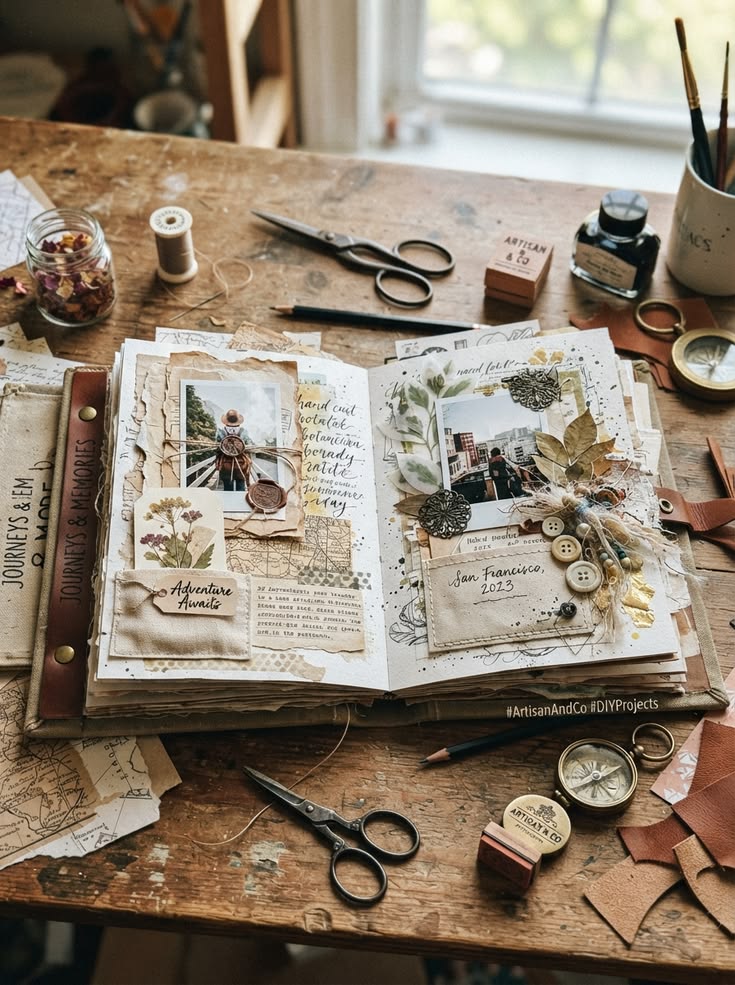
This is one of the reasons I love scrapbooking and journalling so much, because there is something almost meditative about collecting these little pieces of your life and giving them somewhere to live, rather than allowing them to disappear into the blur of everything else that happens around them.
You don’t have to write beautifully, have a particularly profound thought to share, or even know exactly why you are recording something. You can simply stick something onto a page, make a little sketch, press a leaf between the pages, write down a sentence you don’t want to forget, record how your energy felt that week, make a note of something you noticed in the garden or write down what you happened to be craving that day.
There is no requirement for every page to become a deep exploration of your inner world; sometimes the most valuable thing you can do is simply document what is happening. Because when you document something, you create the possibility of seeing it again.
And when you begin seeing the same things again and again, you begin to notice patterns.
Your life is full of patterns
I think we often talk about finding our rhythm as though it is something we need to discover somewhere outside ourselves, perhaps through a particular routine, planner, productivity system or set of rules, when in reality much of the information we need is already being communicated through our own experiences every day.
The difficulty is that most of us are moving too quickly to notice it.
Your body is constantly giving you information about how you are experiencing your life: Your energy changes, your appetite changes, your creativity changes, your desire for connection changes, your need for rest, your capacity, your emotions they are all always changing.
And these things aren’t necessarily problems that need fixing; sometimes they are simply information.
Perhaps you notice that you naturally want more quiet as autumn arrives.
Perhaps you realise that you have less interest in filling every evening with plans once the days become shorter.
Or you notice that certain foods feel more nourishing at particular times of the year, or that your creativity begins to change as the light changes, or that you naturally want to spend more time making things, reading, cooking or being at home.
Maybe you notice that there are particular times when you feel more outward-facing and others when you want to retreat, reflect and spend more time in your own company.
Or you notice that certain environments leave you feeling expanded and energised, while others consistently leave you feeling overwhelmed or depleted.
These observations might initially feel completely random, but when you record them over a longer period of time, they can begin to form a pattern. And this is where journalling becomes so much more than simply writing things down.
The value of looking back
One of the most beautiful things about keeping a journal is that you don’t have to understand everything while it is happening, sometimes you simply need to record the experience and allow the meaning to emerge later.
When you look back through your journal after a season, or perhaps after an entire year, you start to see things that you simply couldn’t see while you were living through them, because it is only when you create some distance and look back across a longer period of time that the threads begin to emerge.
Perhaps you always seem to need more rest at a certain point in the year, your creativity comes in waves rather than following the consistent pattern you once believed it should, or you notice that you feel more social during some parts of the year and more inward during others. Maybe your relationship with food changes with the seasons.
Perhaps there are certain times when you naturally want to begin new projects, while other periods seem much better suited to finishing, reflecting or simply allowing things to settle, or you discover that some of the things you thought were personality traits are actually responses to particular circumstances, environments or levels of capacity.
And slowly, through paying attention, you begin to understand yourself differently.
This is one of the things I love most about working with the seasons, because they give us an opportunity to step away from the idea that we are supposed to feel the same every day, every week and every month of the year.
Nature isn’t static.
Why would we expect ourselves to be?
Autumn gives us a different kind of invitation
As we move into October, autumn is becoming increasingly visible around us, but it is worth remembering that autumn isn’t simply about leaves changing colour and everything becoming cosy.
There is a deeper movement taking place. The natural world is gradually moving towards conservation, preparation and retreat, with plants putting their energy into roots and seeds, trees releasing what they no longer need and wildlife responding to the changing availability of food and shelter. Hedgehogs are busy looking for food before hibernation, while seedheads and fallen leaves become important habitats and food sources for wildlife through the colder months, many birds are migrating as the cold creeps in, and some are arriving to spend the winter here.
There is movement everywhere, but it isn’t the same kind of movement we associate with spring and summer, it’s a movement towards gathering, releasing, preparing and conserving. And we can learn something from that.
Autumn doesn’t ask us to become less alive, it simply asks us to become more discerning about where we place our energy.
Noticing before changing
This is why I think there is such value in developing the practice of noticing before immediately deciding that something needs to change.
If you are tired, notice it.
If you are energised, notice it.
If you are craving more connection, notice it.
If you are craving solitude, notice it.
If you keep finding yourself drawn towards a particular creative project, notice it.
If you repeatedly feel uncomfortable in a particular situation, notice it.
If you feel unexpectedly joyful about something small, notice that too.
We don’t have to immediately turn every observation into an action point. Sometimes we can simply allow ourselves to become curious. When we’re constantly judging our experiences as good or bad, productive or unproductive, healthy or unhealthy, successful or unsuccessful, we can miss the information contained within them.
Curiosity creates a little more space, tt allows us to ask, What is happening here?, and sometimes that question is far more useful than immediately asking, How do I fix this?
Journalling as a practice of self-trust
This is where journalling can become such a powerful practice: it gives you somewhere to notice before you act, it allows you to gather the evidence of your own experience rather than relying entirely on somebody else to tell you what you should be doing, as well as giving you a record of what your body, energy, emotions, creativity and life have actually been showing you over time.
And the beautiful thing is that you can keep doing this year after year.
Your journal becomes a record not only of the seasons happening outside you, but of the seasons you move through yourself, giving you the opportunity to look back at last autumn and compare it with this autumn, to notice what has changed and what has stayed the same, and to recognise the ways in which your own life seems to move through rhythms that you may never have consciously noticed before.
There is something incredibly grounding about having this record of your own experience, particularly in a world where we are constantly being given information about how you should feel, what you should be doing and what your life should look like at any particular point in time.
The more you pay attention to your own patterns, the less you need to measure yourself against somebody else’s.
You begin to understand that perhaps you don’t need to be productive in the same way every day, that perhaps your energy isn’t supposed to remain constant throughout the year, and that perhaps the things you need in January are not the same things you need in October, December or June.
This is where I think journalling becomes a way of developing a relationship with yourself. A relationship built through observation rather than judgement, through curiosity rather than criticism, and through repeatedly showing yourself that you are willing to stop and listen to what is happening within you.
Your journal becomes a map
Over time, these tiny observations become something much bigger. You begin to build a record of your own seasons.
You might look back and realise that every autumn you become more reflective, or that you always seem to have a burst of creativity when the evenings first begin to draw in. Notice that you tend to overcommit during periods when your energy is high, only to need much more recovery afterwards, you might recognise that there are certain environments where you consistently feel more like yourself, or that some of your strongest ideas arrive when you finally give yourself enough space to stop filling every moment.
And gradually, these observations become a kind of personal map.
Not a set of rules telling you how you should live, but a collection of information gathered from your own experience — that is where self-trust begins to grow. Not because you suddenly have all the answers, but because you have gathered enough evidence from your own life to begin recognising what is true for you.
Notice the season you are in
This is my invitation to you this autumn. Not to rush towards the end of the year, or immediately start planning the next version of yourself. Not to turn the changing season into another opportunity for productivity, but simply to notice.
Notice what is changing around you.
Notice what is changing within you.
Notice what you are drawn towards.
Notice what you are beginning to release.
Notice where your energy naturally wants to go.
Notice what feels nourishing.
Notice what feels heavy.
Notice what keeps returning to your attention.
Notice the small things that make an ordinary day feel meaningful.
Your life is constantly communicating with you through these little details, through your energy, your body, your emotions, your desires, your creativity, your relationships and the subtle things that repeatedly catch your attention. You don’t necessarily need to have an answer for everything you notice.
Sometimes noticing is enough.
And then, over time, the things you notice begin to tell you something.
These things may seem small, but when you begin collecting them, they tell a story.And eventually, when you look back, you may find that the story they tell is not simply a record of where you have been, but a map of who you are, the rhythms you live by, the things that matter to you and the ways in which your own seasons have been unfolding all along.
The Seasonal Journal
This is what I hope the Seasonal Journal becomes for you: not another thing to keep up with, and certainly not another habit that you can feel guilty about when you miss a week, but a little space each week where you can pause long enough to pay attention, collect the pieces of your life and give yourself the opportunity to notice what is happening both around you and within you.
A place for the photograph you don’t want to forget, the leaf you found on your walk, the recipe you loved, the thought that stayed with you, the change in your energy, the thing you are learning about yourself, the small moment that made you laugh, or simply a few words about what this particular season of your life feels like.
Because these are the things we so often lose.
Not the big milestones, which we tend to remember, but the ordinary details that make up the vast majority of our lives.
The Tuesday afternoon walk.
The first cold morning.
The bird you hadn’t seen since spring.
The cup of tea beside you while you read.
The idea that arrived while you were washing the dishes.
The unexpected feeling of contentment that appeared for no particular reason.
The quiet realisation that something which used to matter to you no longer does.
The new thing you are beginning to want.
The small change you are noticing in yourself.
These moments might not seem important enough to record, but they are precisely the things worth recording because they are the texture of your life, the small mundane moments of joy that draw you into living each day to its fullest instead of just existing.
As we move deeper into autumn, that is a lovely thing to give yourself: the invitation to stop looking only for the big moments and start noticing the little ones too. Because when you learn to notice your life, you begin to understand it.
And when you begin to understand your own patterns, you can make choices that are more closely aligned with the person you actually are, rather than continually trying to become the person you think you are supposed to be.
You don’t need to wait for a Monday, a New Moon, the beginning of a new month or the start of a new year. You can begin exactly where you are.
You can simply begin noticing.
xo Emily

...then live in it
The membership where Lifestyle Planning Meets Wellness + Nervous System Support
SEASONal SOUL inner circle
BUILD
YOUR SEASONAL WORLD
Your ongoing space for living in rhythm with the seasons, cycles and energy of now. Seasonal Soul Membership is designed to help you **embody your seasonal rhythm**, rather than simply learn about it.
Be the first to comment